Moonshot Nation

As long as we’re locked in the orbit of someone else's Moonshot, we’ve lost control of our future.
You can’t make a country great again without a Moonshot. Back in January, Donald Trump announced a big, beautiful $500 billion investment aimed at securing American dominance in artificial intelligence. That’s almost twice as much as was spent on the original Apollo programme, when measured in today’s money. Eat your heart out Jack Kennedy.
But Trump being Trump, the grand ambition was underwritten with other people's money. Companies like Open AI will foot the bill for the enormous investment in critical AI infrastructure. In return, the Trump administration will exempt the American AI giants from regulation for a decade.
This Moonshot is just one track in a frenzied race for computing power that will unleash more than $6 trillion of global investment in data centres by 2030, and potentially reshape the balance of power in our world. “The leading AI giants are no longer merely multinational corporations,” argues Karen Hao, the author of a new book about the global footprint of AI, “they are growing into modern-day empires”
 Karen Hao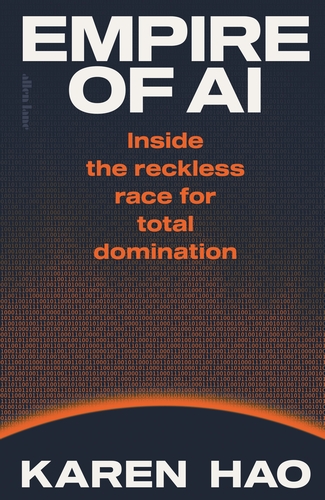
Ireland is locked in the tractor beam of the new empires. By 2030, one third of our electricity will be diverted to data centres, placing untold pressure on a political system struggling to make good on infrastructural promises. Something’s got to give. But what? The quality of Irish life? Ireland’s economic future? If this is our only choice, we have already lost.
The looming AI arms race demands controlled panic in our public conversation. It is not a temporary crisis to be overcome, but an unravelling of certainty across all dimensions of Irish life. As long as we’re locked in the orbit of someone else's Moonshot, we’ve lost control of our future.
So what’s the Irish moonshot? Where is our strategy for Irish economic sovereignty in a world of AI empires? To start, we need to hold contradictory thoughts in our minds without going mad. Foreign direct investment (FDI) will continue to be the backbone of the Irish economy, but we can only grow taller and stronger through domestic innovation.
By 2030, Enterprise Ireland hopes to support 275,000 jobs in innovation-driven Irish businesses, and produce home-grown entrepreneurs with billion dollar ambitions. “The strengthening of Ireland’s entrepreneurial economy isn’t merely a complementary strategy to FDI,” investor and start-up veteran DC Cahalane wrote in a recent blog post. “It must become an equal pillar of national economic policy.”
Our homegrown innovators face tough choices from the get-go. Instead of competing directly with large-language models (LLMs), Irish entrepreneurs will likely scale on the application layer of imperial AI, fixing problems in industries where Ireland has deep expertise, like medical research, financial services, and agriculture. But the application layer is a zone of uncertainty, with many early investments in generative AI ending up in a “trough of disillusionment”.
I find it useful to distinguish between “vertical” AI opportunities, in which innovators are tenants in technology stacks built by big companies, and “horizontal” AI potential, where innovators embrace open source models or pursue opportunities which do not require a dependence on LLMs. This horizontal layer is fertile soil for a sovereign Moonshot.
Deep Mind’s Alpha Fold won a Nobel prize for breakthrough research into protein structures which used a non-generative AI model. A range of deep learning techniques are being used by medical researchers seeking life-saving early detection of cancer. Relatively inexpensive and energy-efficient AI models are being used for tasks such as weather prediction and climate modelling.
The horizontal opportunity for small teams of Irish innovators is to use narrow-purpose AI tools to produce outsized results in life-changing fields not dominated by AI Empires. In my experience, this independence can trigger virtuous feedback loops between Ireland’s domestic and foreign innovation systems. After working for US multinationals, Aine Kerr and I created a start-up called Kinzen which relied on open-source natural language processing transformers to detect online threats. With these tools, we solved a problem for a big technology company, which bought our company and invested in R&D in Ireland.
An Irish moonshot demands a radical expansion of publicly-funded science research, particularly in the field of sustainable energy and new frontiers like quantum computing. Silicon Valley’s greatest advances were built on research emerging from public institutions, from the Apollo moonshot to the core functions of the iPhone. Public funding is where Ireland might gain an edge right now, given Donald Trump’s savage cutbacks in the fields of science and technology, and the privatisation of public research. Back in 2004, just 20% of American PhD students in AI got a job in the private sector. By 2020, 70% made the transition from public to private.
Ireland has a lot of catching up to do. Public research funding exceeded €1 billion for the first time in 2023, but the private sector delivers the bulk of the €8 billion spent on R&D every year. Ibec says Ireland must increase public investment in research to 1% of Gross National Income to become a European innovation leader.
The ultimate test of Moonshot innovation will be to move fast and fix things in Irish life. Our political system is trapped in an impossible contest of immediate demands without a compelling story of the future. The Moonshot can be that story, if it looks beyond metrics of national income or job growth, to measures of community well-being, social mobility, and generational fairness. “In prioritising national growth over local opportunity,” says British economist Andy Haldane, “governments are praying at the wrong altar and chasing the wrong rainbow.”
Don’t mistake Moonshot innovation for empty optimism. It anticipates the problems we’re not talking about, incorporates the known unknowns of accelerating technology, and confronts impossible trade-offs. We can’t expect Empires of AI to drain community resources, push up energy prices and still have a healthy democracy. We can’t expect artificial intelligence to be a force for good if we don’t ask the right questions, pick the right fights, starting right now. From such harsh realities emerge the bravest Moonshots.
Quote of the Week
Dario Amodei, CEO of Anthropic with the pithiest of pithy predictions about our AI future. If only the solution was as easy as the quip (and to be fair, Amodei did give some vital context)
"Cancer is cured, the economy grows at 10% a year, the budget is balanced — and 20% of people don't have jobs."